Author Guidelines

Important Dates

Full Paper Submission June 30, 2027
Notification to Authors August 20, 2027
Registration Deadline September 5, 2027
Camera Ready Submission September 30, 2027
Conference Date October 7–8, 2027

Submission Guidelines

Authors are invited to submit original, previously unpublished research papers that describe substantial new work and are not currently under review at, or published in, any other conference or journal. All papers must be written in English.

Papers must be prepared using the official IEEE conference proceedings template (two-column format). Use the A4 version of the template for ISEC 2027 — do not use the US-Letter version, and do not alter the margins, column widths, fonts, or line spacing prescribed by the template.

The maximum length is 5 pages, including all figures, tables, and references. Up to 2 additional pages are permitted subject to an over-length page charge. Do not add page numbers — the template handles pagination.

Prepare your paper with one of the official IEEE templates:

Each submission is checked for originality; the similarity index of a submitted paper should not exceed 15%. Papers outside the scope of the conference, not in the IEEE format, or exceeding the page limit may be desk rejected without review.

For any issues related to the submission process, contact info@isecconf.com.

Submit Paper

Camera-ready Instructions

Once your paper is accepted, you must (1) address every reviewer comment, (2) keep the paper within the page limit in the official IEEE A4 template, and (3) remove all template placeholder text. The camera-ready version is then prepared for IEEE Xplore in the three steps below. Papers that do not pass IEEE's quality review, or whose author does not register and present, will be excluded from IEEE Xplore.

1
Generate an IEEE Xplore-compatible PDF (IEEE PDF eXpress). Convert your final paper to PDF and validate it with IEEE PDF eXpress. Create an account using the ISEC 2027 Conference ID (to be announced with the acceptance notification) and your email address. Upload the paper; you will receive an email stating whether it passed or failed validation. Your PDF must pass before proceeding.
2
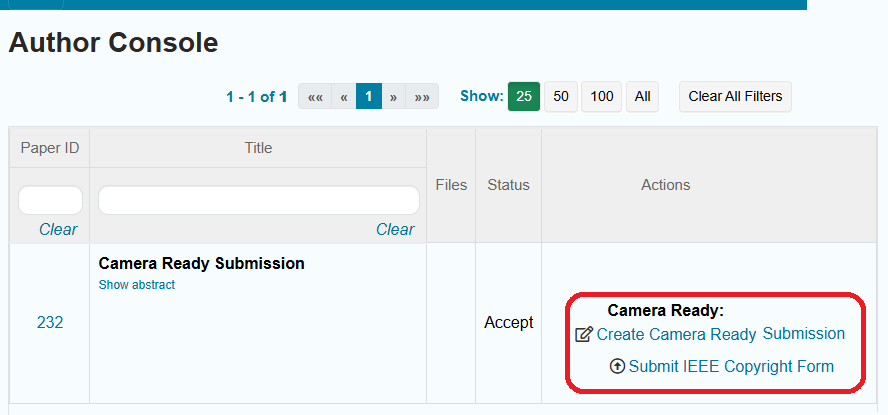
Submit the camera-ready package. Log in to the conference submission system, open the Author Console, choose “Create Camera-Ready Submission” and upload: the IEEE PDF eXpress–approved PDF, and the final source files (LaTeX .zip including .tex, .bib/.bbl and figures, or the final Word .docx). Click Submit. Camera-ready submissions are not accepted by email.
3
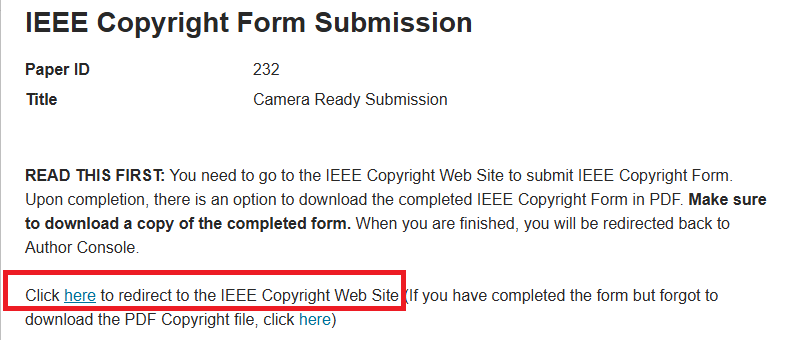
Complete the IEEE Copyright Transfer Form (eCF). At least one author must complete the IEEE electronic Copyright Form through the submission system by providing the corresponding author's details. A signed IEEE copyright transfer is required for the paper to appear in the proceedings and IEEE Xplore.
Use the same official IEEE templates for the camera-ready paper:
How to upload the camera-ready materials

Follow these steps in the conference submission system

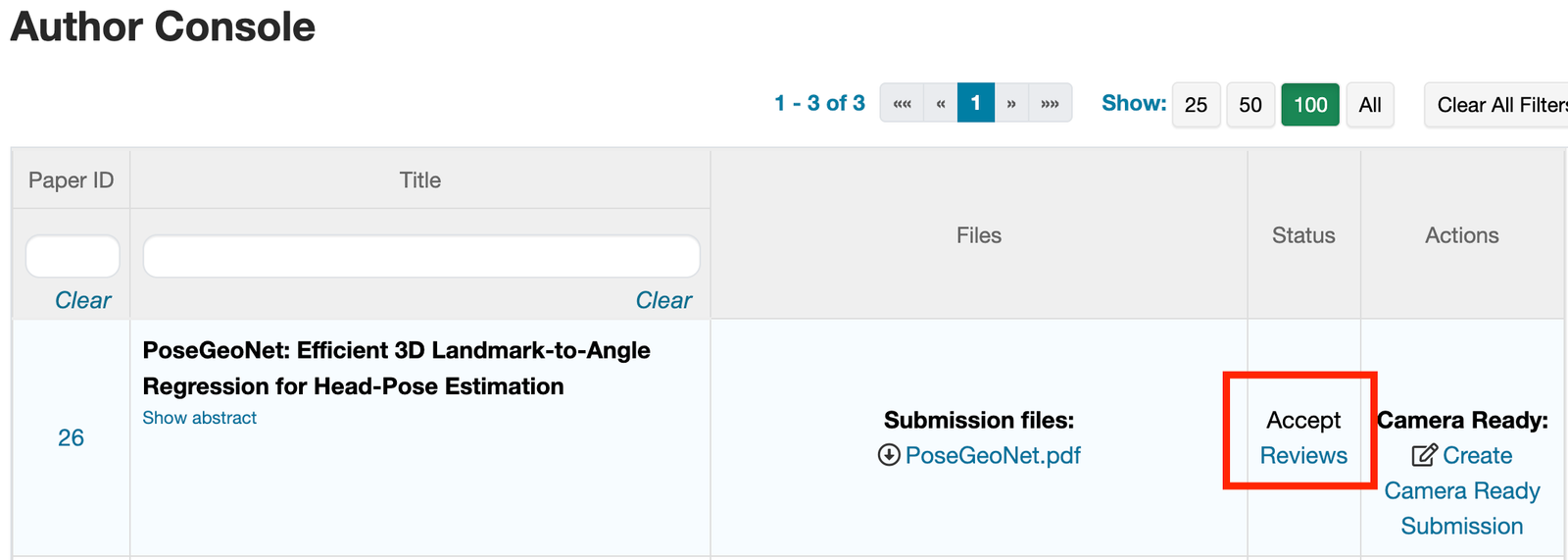
1 Log in to your author account and open the Author Console. Click Reviews to read every reviewer comment and revise the paper accordingly.
2 Validate the final PDF with IEEE PDF eXpress and confirm it passed.
3
On your submission, click Create Camera Ready Submission and upload:
  • The IEEE PDF eXpress–approved PDF
  • The final source files (LaTeX .zip or Word .docx)
4 Click Submit IEEE Copyright Form, complete the IEEE electronic Copyright Form on the IEEE site, and download a copy of the completed PDF.
5 Confirm all files are correctly uploaded and click Submit.
Camera-ready submissions will not be accepted via email.
Reviewer comments: In the Author Console, open your accepted submission and click Reviews to read the reviewer feedback before finalising. Address every point before uploading the camera-ready version.
Author Console showing an accepted paper with links to Reviews and Create Camera Ready Submission
Author Console — open your accepted submission to view reviews and start the camera-ready.
Author Console camera-ready actions: Create Camera Ready Submission and Submit IEEE Copyright Form
Creating the camera-ready submission and the IEEE Copyright Form from the Author Console.
IEEE Copyright Form Submission page linking to the IEEE Copyright Web Site
The IEEE Copyright Form step redirects to the IEEE Copyright Web Site; download the completed PDF before returning.
Camera-Ready Submission Checklist for Authors

Go through every point before uploading your files. This checklist follows the IEEE conference paper format.

Template & format
1
Use the official IEEE conference template (LaTeX or Word), A4 size. Do not use the US-Letter version.
2
Do not change margins, column widths, fonts, or line spacing to fit the page limit — every value is set by the template.
3
Paper is within 5 pages (up to 2 extra pages only with the over-length charge paid).
4
Do not add page numbers — the template handles pagination.
5
All template placeholder / sample text (e.g. “This electronic document is a live template…”) has been removed.
Title & authors
6
Title contains no symbols, special characters, footnotes, or math.
7
Author names are final and consistent. Do not include titles such as Dr., Prof., PhD, Engr., Mr., or Ms. in the author line.
8
Names run left to right and wrap to the next line — not grouped by affiliation or set in columns.
9
Each affiliation block follows the IEEE 5-line format: (1) Given Name Surname, (2) Department, (3) Organisation, (4) City, Country, (5) Email or ORCID.
10
Affiliations are kept succinct; departments of the same organisation are not differentiated.
Abstract & keywords
11
Abstract has no citations, equations, tables, figures, footnotes, or special characters.
12
Abstract begins with the run-in head “Abstract—” in italic.
13
Index terms / keywords follow the abstract, prefixed “Keywords—” (about 4–6 terms).
Text & structure
14
Section headings use the template’s built-in Heading styles; do not number headings manually.
15
Every abbreviation and acronym is defined at first use in the text (common ones such as IEEE, SI, MKS need no definition).
16
SI (MKS) units are used as primary units; units are not mixed and are either all spelled out or all abbreviated.
17
A zero precedes every decimal point (“0.25”, not “.25”); “et al.” has no period after “et”.
Figures & tables
18
Figures and tables sit at the top or bottom of a column, never in the middle; large ones may span both columns.
19
Figure captions go below the figure; table titles go above the table.
20
Each figure is cited in the text before it appears and labelled “Fig. 1” (even at the start of a sentence).
21
Figure text is legible; line art is ideally 600–1200 dpi or vector, with fonts embedded. Axis labels use words with units in parentheses, e.g. “Magnetization (A/m)”.
22
Figures remain understandable in black and white — do not rely on colour alone.
23
Tables are real, editable tables — not pasted as images.
Equations
24
Equations are editable (not images), numbered consecutively with the number flush right in parentheses, e.g. (1).
25
Refer to equations as “(1)”, not “Eq. (1)” — except at the start of a sentence.
26
Roman symbols for variables are italicised; Greek symbols are not. Every symbol is defined at first use.
Citations & references
27
In-text citations are numbered in square brackets, e.g. [1], [2], [3]–[5]; do not use superscripts or APA-style “Miller (2020)”.
28
Cite as “[3]”, not “Ref. [3]” or “reference [3]”, except at the start of a sentence.
29
All author names are given unless there are six or more, in which case “et al.” is used.
30
Every reference is complete: authors, full title, venue, volume/issue, pages, year, and DOI where available. Follow IEEE style only — do not mix in APA, ACM, or Harvard.
31
Every in-text citation appears in the reference list and every reference is cited in the text. AI-suggested references have been verified and completed.
Final checks
32
“Acknowledgment” is spelled without an “e” after the “g”; funding is acknowledged in an unnumbered first-page footnote.
33
“data” is treated as plural; subscripts use zero (0), not the letter “o”; the prefix “non” is joined without a hyphen.
34
The whole paper has been proofread; grammar, spelling, and scientific clarity are verified.
35
The final PDF has been validated by IEEE PDF eXpress and passed.
36
The camera-ready package contains the approved PDF and the final source files, and the IEEE Copyright Form has been completed.

For any issues related to the submission process, please feel free to contact us: info@isecconf.com

Presentation Instructions

All authors are requested to follow the following guidelines for preparation of your presentation slides:

  • The allocated time for each paper is 15 minutes. The presenter will present the paper for 10-12 minutes followed by a 1-3 minutes Question/Answer session.
  • We encourage you to put Conference logo, and Title in the background of presentation.
  • Authors participating online must make sure to have stable internet connection.
  • The slide design should be as simple as possible. Avoid using paragraphs in the slides. They should be compact and to the point.
  • Audiance are requested to ask questions during the Q/A session at the end of presenation.

Proceedings & Indexing

All accepted and presented papers at ISEC 2027 will be submitted to IEEE for publication and inclusion in the IEEE Xplore® Digital Library, subject to IEEE's quality review and approval.
  • IEEE will conduct quality checks on the accepted papers; only papers that pass these checks and are presented at the conference will be forwarded for inclusion in IEEE Xplore.
  • At least one author of each accepted paper must complete a full (non-student) registration and present the paper at the conference.

IEEE technical co-sponsorship has been applied for and is pending approval.

Publication Ethics & AI Policy

ISEC follows strict publication-ethics standards to protect research quality, originality, and reviewer confidentiality.

Peer Review Integrity

All submitted papers will be reviewed by at least 2 independent reviewers. Additional reviewers will be consulted if required. Paper acceptance is based on originality, significance, technical soundness, and clarity of presentation.

Plagiarism and Similarity Check

All submissions will be screened using plagiarism detection software (e.g., iThenticate or Turnitin). Significant overlap, duplicate submission, or unattributed reuse of text, figures, or results will lead to rejection. Similarity percentages are evaluated with editorial judgment, and context matters.

Originality Requirement

Submitted papers must be original, previously unpublished, and not under review elsewhere. Proper citation is mandatory for all reused ideas, methods, data, or figures. Self-plagiarism and redundant publication are not permitted.

Manuscript Compliance

All papers must be formatted according to the given template ( IEEE conference template).

Use of Generative AI Tools

Authors may use AI tools (e.g., ChatGPT or similar) for language improvement, grammar correction, or limited assistance. However, authors remain fully responsible for the accuracy, originality, citations, and integrity of the manuscript.

Mandatory AI Disclosure

If AI tools are used beyond minor language polishing (e.g., generating text, code, figures, or analysis support), authors must disclose this in the Acknowledgment section, clearly stating the tool name and how it was used. AI tools cannot be listed as authors.

Reviewer Confidentiality

Reviewers and editors must not upload submitted manuscripts to external AI systems or third-party platforms. All peer-review materials are strictly confidential.